
 English
 简体中文
简体中文
In a world where comfort and performance often depend on staying cool, a simple accessory is stepping up: the cooling wrist wrap. More than just a piece of cloth, these wraps employ clever science to help regulate your body temperature, offering relief from a scorching workout, a hot day, or even a fever. But how exactly does wrapping a band around your wrist lead to a whole-body cooling sensation? The answer lies in the strategic science of human thermoregulation.
Content
The Body’s Thermostat: Why We Get Hot
To understand how cooling wraps work, we first need to appreciate how the body manages heat. Your body’s core temperature is a tightly controlled 37∘C (or 98.6∘F). When you exercise, the chemical reactions that power your muscles generate metabolic heat, raising your internal temperature.
How Your Body Tries to Cool Down
When you overheat, your body automatically kicks in its natural cooling systems:
- Vasodilation: Blood vessels near the skin’s surface widen (dilate) to bring hot blood closer to the cooler external environment, allowing heat to radiate away.
- Sweating: As sweat evaporates from your skin, it draws a significant amount of heat energy away from the body in a process called evaporative cooling. This is the most effective cooling mechanism.
However, in high humidity or intense activity, these natural processes can be overwhelmed. This is where external aids like cooling wraps come into play.
The Cooling Connection: Targeting the Wrist
The wrist might seem like an arbitrary spot, but it is a highly strategic target for cooling. The secret is a specific type of blood vessel and its proximity to the skin.
The Palmar Artery and AVAs
Beneath the thin skin of your inner wrist, major arteries—like the palmar arch—run very close to the surface. Furthermore, this area is rich in Arteriovenous Anastomoses (AVAs).
AVAs are small, specialized blood vessels that connect an artery directly to a vein, bypassing the capillaries. Their primary function is not to deliver oxygen but to act as heat exchangers. When your body is hot, the AVAs open up, allowing a high volume of blood to flow rapidly through this area where heat can be easily shed to the environment.
When you apply a cool compress to this area, you rapidly cool the blood flowing through these open AVAs. This chilled blood then circulates back to your core, providing a systemic cooling effect.
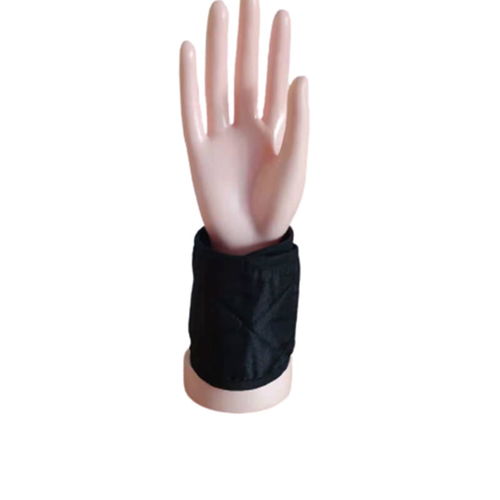
The Technology Inside the Wrap
Cooling wrist wraps are generally designed around two primary technologies: specialized cooling fabrics or phase-change materials.
Evaporative Cooling Fabrics
The most common wraps use a high-tech synthetic fiber or polymer material that excels at moisture management:
- Absorption: The material quickly soaks up water (or sweat).
- Dispersion: The material then spreads the water across a large surface area, maximizing exposure to the air.
- Evaporation: As the water evaporates, it draws heat from the fabric, which in turn draws heat from your skin. This creates a powerful, sustained cooling effect as long as the wrap remains damp.
Phase-Change Material (PCM) Wraps
Some advanced wraps utilize Phase-Change Materials (PCMs), often in the form of gel packs inserted into the wrap.
PCMs are substances that absorb and release large amounts of heat when they change state (e.g., from solid to liquid) at a specific temperature. The advantage of PCMs is that they maintain a consistent, moderately cool temperature for an extended period without needing ice. For example, a PCM might be engineered to solidify at (). When the wrap is warmer than this, the PCM absorbs the excess heat from your body to melt, providing a stable, gentle cooling sensation until it has fully melted.
Benefits Beyond the Wrist
The cooling effect on the wrist is not just a local sensation; it contributes to tangible benefits for overall health and performance.
- Reduced Core Temperature: By efficiently cooling the blood, these wraps can help lower the body’s overall core temperature, potentially delaying the onset of heat exhaustion.
- Improved Athletic Performance: When the body overheats, the nervous system sends signals to slow down. Maintaining a lower core temperature can allow athletes to sustain a higher intensity for longer.
- Faster Recovery: Applying cooling to the AVAs after a workout can help accelerate the cool-down process, reducing stress on the cardiovascular system.
Whether you’re an athlete looking for a competitive edge or simply seeking relief on a sweltering summer day, the humble cooling wrist wrap leverages elegant physiological science to keep the body’s engine running efficiently and comfortably cool.


 3rd Floor, East Gate, No. 2599 Park Road, Sheng Ze Town, Wu Jiang District, Suzhou City, Jiangsu Province
  +86- 0512-63519080
 +86-13584404311
  FQsales1@163.com