
 English
 简体中文
简体中文
Content
- 1 Why Women Are Turning to Cooling Vests More Than Ever
- 2 The Three Main Types of Women's Cooling Vests Explained
- 3 Comparing Cooling Vest Types Side by Side
- 4 Fit and Sizing: Why Women-Specific Design Matters
- 5
- 6 Best Uses for a Cooling Vest for Women
- 7 Features Worth Paying More For
- 8 How to Care for and Extend the Life of Your Cooling Vest
Why Women Are Turning to Cooling Vests More Than Ever
Heat management is not a niche concern. Women working outdoor jobs, managing hot flashes during menopause, training in warm climates, or simply trying to stay functional during summer heat are all dealing with the same problem: standard clothing does nothing to actively reduce body temperature. A well-chosen cooling vest for women addresses that gap directly — not by wicking sweat like athletic fabric, but by actively pulling heat away from the body's core.
Interest in women's cooling vests has grown alongside broader awareness of heat-related health risks, particularly for people working in construction, agriculture, warehousing, and outdoor events. At the same time, women going through perimenopause and menopause have driven demand for lighter, more discreet cooling options that work under regular clothing. The result is a market that now offers far more variety than it did even five years ago — which makes choosing the right product both easier and more confusing.
The Three Main Types of Women's Cooling Vests Explained
Not all cooling vests work the same way. The technology behind each type determines how long it stays cool, how it fits into your routine, and what conditions it's best suited for. Understanding the differences upfront saves you from buying the wrong product for your needs.
Evaporative Cooling Vests
Evaporative cooling vests are soaked in cold water before use. The vest material — typically a polymer-based fabric or a specialty crystal layer — absorbs water and releases it slowly through evaporation, drawing heat away from the body in the process. Activation takes around 1–3 minutes of soaking, and a single soak typically provides 5–10 hours of cooling depending on ambient temperature and humidity. These vests are lightweight, require no ice or refrigeration, and are easy to reactivate throughout the day by re-wetting. The main limitation is performance in high-humidity environments: when the air is already saturated with moisture, evaporation slows significantly and so does cooling effectiveness.
Phase Change Cooling Vests
Phase change vests use insert packs filled with a material — most commonly a salt-based compound with a melting point around 58–65°F (14–18°C) — that absorbs heat as it transitions from solid to liquid. The packs are pre-cooled in a refrigerator or cooler and slot into pockets built into the vest. Once inserted, they provide consistent cooling at a fixed temperature for roughly 2–4 hours before needing to be swapped or re-chilled. Phase change vests perform well in high-humidity conditions where evaporative vests fall short, and they deliver more consistent temperature regulation. The trade-off is weight — the packs add noticeable bulk — and the need to have a cooler or refrigerator accessible for recharging.
Ice Pack Cooling Vests
Ice pack vests use compartments designed to hold standard ice packs or crushed ice. They deliver the most intense initial cooling of the three types and are the most affordable option. Duration is shorter — typically 1–2 hours before the ice melts — and the weight of ice packs makes them less practical for all-day wear or activities that require a lot of movement. They're most commonly used in high-heat environments where intense short-duration cooling matters more than portability, such as pre-cooling before athletic events or brief outdoor work stints.
Comparing Cooling Vest Types Side by Side
Here's a quick reference for choosing between the three main types based on your priorities:
| Type | Cooling Duration | Works in Humidity | Weight | Best Use Case |
| Evaporative | 5–10 hours | Limited | Very light | Dry heat, all-day outdoor wear |
| Phase Change | 2–4 hours per pack | Yes | Moderate | Industrial work, humid climates |
| Ice Pack | 1–2 hours | Yes | Heavy | Short bursts, athletic pre-cooling |
Fit and Sizing: Why Women-Specific Design Matters
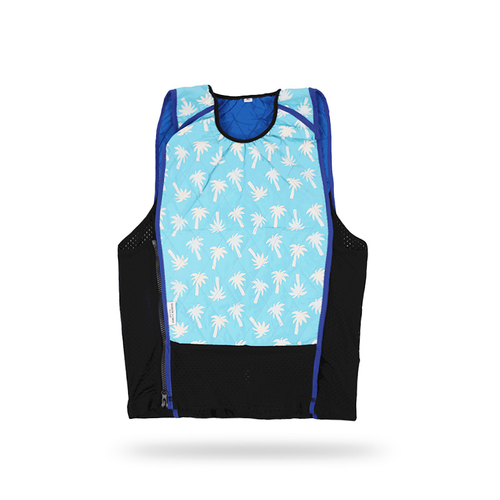
One of the most common complaints about cooling vests is poor fit — and for women, this problem is more pronounced because most early cooling vest designs were built around a male body shape. A vest sized for a male torso typically sits too wide at the shoulders, gaps at the sides, and fails to make proper contact with the areas of the body where heat dissipation matters most: the chest, upper back, and around the torso. Poor contact means poor cooling performance, regardless of how good the underlying technology is.
Women-specific cooling vests address this with narrower shoulder construction, a more contoured torso fit, and in some cases dart-seamed fronts that accommodate chest shape without creating pressure points. When shopping, look for vests that are explicitly designed for female body proportions rather than just sized down from a unisex pattern. If you're between sizes, size up — a slightly loose vest is easier to work with than one that restricts movement or bunches under the arms.
Fit Checklist Before You Buy
- Shoulder seams should sit at or slightly inside your natural shoulder line, not hanging off the edge
- The vest should lie flat against your upper back with no significant gap between fabric and skin
- Side adjustability (hook-and-loop or buckle straps) helps fine-tune fit without restricting arm movement
- Check that cooling pack pockets sit centered on the front and back panels, not shifted to the sides
- The vest should allow a full range of arm motion — raise both arms fully and confirm there's no binding at the armhole
Best Uses for a Cooling Vest for Women
The right cooling vest depends heavily on what you're actually using it for. The same product that works well for a warehouse worker in Phoenix is probably not the best choice for a woman managing menopause symptoms in an air-conditioned office. Matching vest type and design to your specific context is what separates genuinely useful heat relief from a product that sits unused in a drawer.
Outdoor Work and Labor
For women in physically demanding outdoor roles — landscaping, construction, agriculture, traffic management, event staffing — a phase change or evaporative vest worn over or under a work shirt is the most practical option. Look for vests with ANSI-compliant reflective trim if high-visibility is required on your worksite. Durability matters here: vest shells should be reinforced at the seams and resistant to snagging on equipment. Some manufacturers offer cooling vests designed to meet specific industry safety standards, which is worth checking if your employer has PPE requirements.
Hot Flashes and Menopause
A lightweight evaporative cooling vest worn under a blouse or jacket is increasingly popular among women managing vasomotor symptoms from menopause. The key requirements here are different from workwear: the vest needs to be thin enough to be discreet under clothing, soft enough against bare skin for extended wear, and quiet in terms of any crinkle or rustling from the material. Some products in this category are specifically designed as undergarments with a smooth outer surface and minimal profile. Cooling duration matters less than in outdoor work settings — even 30–60 minutes of relief during a hot flash episode is meaningful.
Running, Hiking, and Outdoor Sports
For active use, weight and freedom of movement are the primary considerations. Lightweight evaporative vests that double as athletic outerwear — designed to look like a running vest rather than safety equipment — are the most practical choice. Some are cut specifically to layer over sports bras without bunching. For endurance sports or hiking in high heat, pre-cooling with an ice pack vest before activity and then switching to a lighter evaporative option during exercise is a strategy used by athletes in hot-weather events.
Medical and Condition-Related Heat Sensitivity
Women with conditions including multiple sclerosis, lupus, hyperhidrosis, or certain medications that impair thermoregulation often have a clinical need for consistent body temperature management. In these cases, phase change vests with a precise and consistent cooling temperature are generally preferred over evaporative options, since the temperature output is more predictable. If you're managing a medical condition, it's worth discussing vest type and temperature range with a healthcare provider — some phase change materials are available in different melting point formulations, and the right target temperature varies by condition.
Features Worth Paying More For
Budget cooling vests exist at every price point, and not all of them are worth the savings. These are the features that meaningfully affect performance and longevity — worth prioritizing when comparing options:
- Secure pack pockets with waterproof lining: Pockets that seal properly and don't allow condensation to soak through to your clothing make a real difference in day-to-day usability
- Adjustable side closures: Hook-and-loop or buckle side adjustments let you dial in fit over different layers of clothing and account for body changes throughout the day
- Moisture-wicking inner lining: A vest that traps your own sweat against your skin defeats part of its purpose — look for a breathable mesh or moisture-wicking inner surface
- Machine-washable shell: Daily wear in physical conditions means the vest shell needs to be washable without degrading the cooling material — check care instructions before buying
- Replacement pack availability: Cooling packs degrade over time. Confirm that replacement packs are sold separately and are easy to source before committing to a vest system
How to Care for and Extend the Life of Your Cooling Vest
A well-maintained cooling vest lasts significantly longer than one that's poorly stored or cleaned incorrectly. Evaporative vests in particular require attention after use: if stored wet, the polymer materials can develop mildew or lose absorbency over time. After each use, allow the vest to dry completely before storing, and rinse it periodically with clean water to prevent mineral buildup from hard water deposits, which can reduce the material's ability to absorb and release moisture effectively.
Phase change packs should be inspected regularly for leaks or crystallization outside the pack — a sign the seal has been compromised. Store packs flat when not in use and avoid dropping or compressing them when frozen, as repeated impact stress can crack the pack casing. Most quality phase change packs have a rated cycle life of several hundred freeze-thaw cycles; keeping a log of pack age is a useful practice in professional or occupational settings where vest reliability is a safety matter.
For the vest shell itself, follow the manufacturer's wash instructions precisely. Most shells can be hand-washed or machine-washed on a gentle cycle in cool water. Avoid fabric softeners, bleach, or high-heat drying — all of which can degrade both the shell fabric and any polymer cooling layers built into the garment.

 3rd Floor, East Gate, No. 2599 Park Road, Sheng Ze Town, Wu Jiang District, Suzhou City, Jiangsu Province
  +86- 0512-63519080
 +86-13584404311
  FQsales1@163.com