
 English
 简体中文
简体中文
When temperatures climb and you need to stay functional outdoors or in a hot work environment, an evaporative cooling vest is one of the most practical personal cooling solutions available — no power source required, no ice needed, and no bulky equipment to carry. But not every cooling vest works the same way, and the differences between types matter significantly depending on where and how you plan to use one. This guide walks through exactly how evaporative cooling vests work, who benefits most from them, how they compare to other cooling vest technologies, and what to look for when you are ready to buy.
Content
- 1 How an Evaporative Cooling Vest Actually Works
- 2 Types of Evaporative Cooling Vests
- 3 Evaporative vs. Phase Change vs. Ice Cooling Vests
- 4 Who Benefits Most from an Evaporative Cooling Vest
- 5
- 6 How to Choose the Right Evaporative Cooling Vest
- 7 Care and Maintenance of Evaporative Cooling Vests
- 8 What to Look for When Buying: A Practical Checklist
- 9 The Bottom Line on Evaporative Cooling Vests
How an Evaporative Cooling Vest Actually Works
Evaporative cooling is the same physical process that makes sweating effective — when water evaporates from a surface, it absorbs heat energy from that surface in the process, cooling it down. An evaporative cooling vest applies this principle directly by holding water in a specialized fabric or material close to your body, then allowing that water to evaporate slowly over time. As it evaporates, it draws heat away from your torso, lowering your core temperature and reducing the sensation of heat stress.
The key to how well an evaporative cooling vest performs is the evaporation rate — how quickly water moves from the vest material to the surrounding air. This is not constant. It depends on three environmental factors: temperature, humidity, and airflow. Higher temperatures accelerate evaporation; lower humidity allows more water vapor to enter the air; and airflow across the vest surface carries away moisture-saturated air and replaces it with drier air that can absorb more evaporation. This is why evaporative cooling vests perform exceptionally well in hot, dry climates and why their effectiveness is reduced — though not eliminated — in humid conditions.
Most evaporative cooling vests are activated simply by submerging them in water for a specified time — typically 1 to 5 minutes depending on the material — wringing out the excess, and putting them on. The vest then provides cooling for anywhere from 2 to 12 hours depending on construction, ambient conditions, and activity level. The cooling effect is most noticeable when there is some airflow over the vest, whether from wind, walking, or a fan — in completely still air, evaporation slows and the cooling effect diminishes.
Types of Evaporative Cooling Vests
Not all evaporative cooling vests use the same materials or construction. The type of evaporative material determines how the vest is activated, how long it lasts, how much it weighs when wet, and how it feels against the body. Here are the main categories:
Polymer Crystal (SAP) Cooling Vests
Polymer crystal vests use panels filled with superabsorbent polymer (SAP) crystals — the same material used in high-absorbency products — that absorb and hold large quantities of water when soaked. The crystals swell into a gel-like consistency when hydrated and release water slowly through the fabric panels over many hours. SAP-based evaporative vests typically provide 8 to 12 hours of cooling from a single soak, making them ideal for full-shift industrial use. Their main trade-off is weight — once saturated, SAP panels are noticeably heavier than other evaporative materials, which can be fatiguing for workers who are already carrying tools or equipment. They also require 3 to 5 minutes of soaking time for full activation, and the swollen panels add bulk under outerwear.
Evaporative Fabric (PVA) Cooling Vests
Polyvinyl alcohol (PVA) fabric vests use a specialized open-cell material that absorbs water rapidly and releases it through evaporation at a controlled rate. PVA vests activate in under a minute — often just a quick dip and shake — and are significantly lighter than SAP vests when wet. They feel cool immediately on contact with the skin and provide effective cooling for 2 to 4 hours under moderate conditions, or longer in dry, breezy conditions where evaporation is faster. PVA cooling vests are popular for outdoor sports, athletic use, and shorter work periods where weight and pack size matter. The trade-off is duration — they require more frequent re-soaking than SAP vests for extended work sessions.
Wicking Fabric Evaporative Vests
Some evaporative cooling vests use high-performance wicking fabric — similar to athletic moisture-management materials — that spreads water rapidly across a large surface area to maximize evaporation. These vests are the lightest and most comfortable option and dry the fastest, but they hold less water overall and provide shorter duration cooling than SAP or PVA alternatives. They are best suited to active users — runners, cyclists, hikers, outdoor workers who move frequently — where body heat and airflow both contribute to evaporation rate. Some wicking fabric vests are designed to be worn under other garments without adding noticeable bulk.
Hybrid Evaporative Vests
Hybrid vests combine evaporative cooling with other cooling mechanisms — typically phase change material (PCM) inserts or ice pockets alongside evaporative panels. These designs aim to deliver both immediate intense cooling from the PCM or ice element and sustained background cooling from evaporation after the cold inserts warm up. Hybrid vests are heavier and more expensive than pure evaporative designs but can be more effective in high-humidity environments where pure evaporative cooling is less efficient. They are commonly used in high-exertion industrial settings and by military and emergency service personnel working in challenging heat conditions.
Evaporative vs. Phase Change vs. Ice Cooling Vests
Evaporative vests are one of three main personal cooling vest technologies. Understanding how they compare helps clarify which is right for a given situation:
| Factor | Evaporative Vest | Phase Change (PCM) Vest | Ice Vest |
| Cooling Mechanism | Water evaporation | Material phase transition | Ice melt absorption |
| Activation | Soak in water | Freeze or cool inserts | Fill with ice |
| Duration | 2–12 hours | 2–4 hours | 1–3 hours |
| Weight When Active | Light to moderate | Moderate to heavy | Heavy |
| Humidity Performance | Reduced in high humidity | Unaffected by humidity | Unaffected by humidity |
| Recharge in Field | Yes — any water source | Requires freezer or cold water | Requires ice supply |
| Cost | Low to moderate | Moderate to high | Low to moderate |
| Best For | Dry heat, extended shifts, field use | Humid conditions, controlled environments | Short intense heat exposure |
The standout advantage of evaporative vests is field rechargeability — any tap, hose, or water bottle can reactivate them. This makes them the most practical choice for workers and outdoor users who cannot reliably access a freezer or a steady supply of ice during their shift or activity. In low-humidity conditions, their cooling performance also outlasts most PCM and ice alternatives significantly.
Who Benefits Most from an Evaporative Cooling Vest
Evaporative cooling vests are used across a wide range of settings, but they are particularly well suited to certain situations where their specific combination of features delivers the greatest practical benefit:
- Outdoor industrial workers: Construction workers, landscapers, agricultural workers, road crews, and utility workers operating in direct sun and high temperatures are the primary industrial market for evaporative vests. Heat stress is a genuine occupational health risk — OSHA estimates that thousands of workers suffer heat-related illness annually — and evaporative vests are one of the most cost-effective engineering controls available. SAP-based vests that last a full 8-hour shift are the most common choice for this application.
- Warehouse and manufacturing workers: Indoor environments without air conditioning — foundries, warehouses, processing plants, bakeries — can reach dangerous temperatures in summer. Workers in these environments benefit from evaporative vests even where there is limited outdoor airflow, particularly if industrial fans are in use nearby.
- Athletes and outdoor sports participants: Runners, cyclists, hikers, golfers, and tennis players use lightweight PVA or wicking fabric evaporative vests for pre-cooling before competition and for cooling during warm-up or between activity periods. Research on pre-cooling with evaporative vests shows measurable improvements in endurance performance in hot conditions by reducing core temperature before sustained effort begins.
- People with heat-sensitive medical conditions: Multiple sclerosis, hyperhidrosis, and various autoimmune conditions can make heat exposure particularly debilitating. Evaporative vests allow people with these conditions to participate in outdoor activities and maintain function in warm environments that would otherwise be prohibitive. The lightweight, non-mechanical nature of evaporative vests makes them easy to wear continuously during daily activities.
- Military and emergency services personnel: Firefighters, military personnel, and emergency responders working in full personal protective equipment (PPE) face extreme heat stress because the PPE itself prevents normal body cooling through sweat evaporation. Evaporative vests worn under or over PPE provide supplemental cooling in these high-risk environments.
- Event staff and outdoor event attendees: Festival workers, outdoor venue staff, traffic controllers, and sporting event volunteers spending full days in the sun benefit significantly from evaporative vests, particularly SAP or PVA types that can sustain cooling through a full event shift without needing to access a freezer.
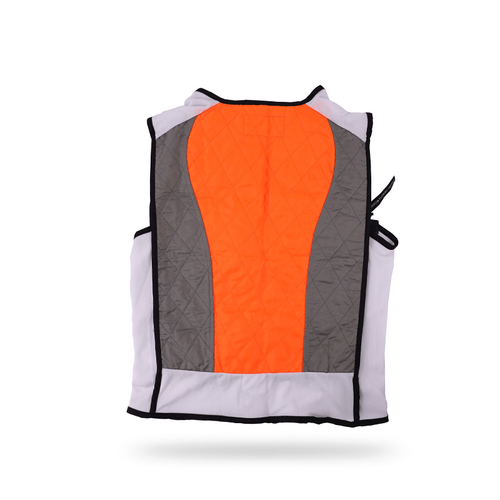
How to Choose the Right Evaporative Cooling Vest
The right evaporative cooling vest depends on your specific use case. Several factors determine which type and specification is the best fit:
Consider Your Climate
Evaporative cooling vests perform best in hot, dry climates where relative humidity stays below 50–60%. In these conditions, a quality evaporative vest will deliver cooling for its full rated duration and feel noticeably cool against the skin throughout. In humid climates — coastal regions, tropical environments, or humid summer conditions in the southeastern United States — evaporative cooling is less efficient because the air is already carrying more moisture and absorbs less evaporation from the vest. In humidity above 70–75%, the cooling benefit is reduced but not eliminated — particularly if there is any airflow. In genuinely humid conditions with no airflow, a hybrid vest with PCM inserts or an ice vest may be more effective.
Match the Vest to Your Required Duration
If you need cooling for a full 8-hour shift without easy access to water for re-soaking, an SAP-based polymer crystal vest is the appropriate choice — it is the only evaporative technology that can sustain cooling through a full shift from a single soak. If you have access to water and can re-soak a vest during breaks, a lighter PVA or wicking fabric vest may be more comfortable for extended wear because of its lower wet weight. For sports and recreational use where sessions are 1 to 3 hours, any evaporative vest type will serve adequately.
Evaluate Weight and Wearability
A saturated SAP vest can weigh 1.5 to 3 kg depending on size — significant for someone who is already working hard. PVA vests weigh 300 to 700g when saturated. Wicking fabric vests weigh even less. If you are wearing the vest for active physical work, particularly work that involves lifting, climbing, or wearing additional PPE, weight is a genuine ergonomic consideration. Heavier vests that shift your center of gravity or restrict movement can increase fatigue and risk, which partly defeats the purpose of using the vest to improve worker function in heat.
Check Coverage Area
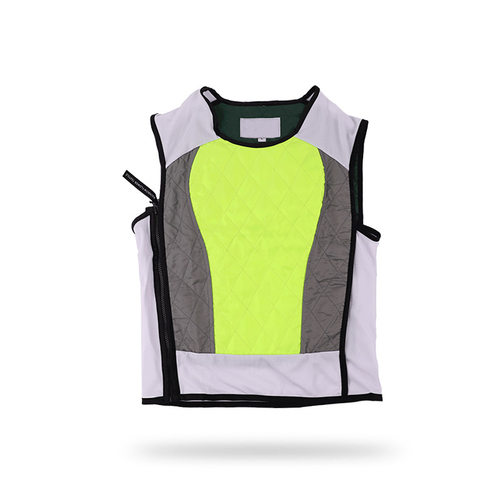
The torso contains major blood vessels close to the surface — particularly along the spine and across the chest — that carry blood to and from the body's core. Cooling these areas effectively lowers systemic temperature. Vest designs vary significantly in how much of the torso they cover. Full-coverage vests that extend across the back, chest, and sides provide more total cooling surface than minimal designs that only cover the upper back. For heat stress management in occupational settings, more coverage is generally better. For sports use where mobility and lightness are priorities, a lighter vest with less coverage may be the right trade-off.
Look for Adjustability and Fit
A cooling vest that does not fit correctly loses contact with the body and reduces its cooling effect. Look for vests with side adjustments, hook-and-loop closures, or buckle systems that allow a snug fit across a range of body shapes and sizes. For workplace applications where vests are shared between workers or used as part of a fleet, size range and adjustability are important procurement considerations. Vests that are too loose flap away from the skin and reduce thermal contact; vests that are too tight restrict breathing and movement.
Care and Maintenance of Evaporative Cooling Vests
Evaporative cooling vests are durable products that should last multiple seasons with correct care. Here is how to maintain them properly:
- Drying between uses: After use, allow SAP and PVA vests to dry completely before storing. Storing a damp vest in a sealed bag or container promotes mold and bacterial growth, which produces odor and can degrade the vest material. Hang the vest in a ventilated area to dry fully.
- Cleaning: Most evaporative cooling vests can be hand washed with mild soap and lukewarm water. Avoid machine washing SAP vests — the agitation can damage the polymer panels. Check the manufacturer's instructions for your specific vest. Rinse thoroughly to remove soap residue, which can reduce evaporative performance.
- Mineral buildup: In hard water areas, mineral deposits can accumulate in SAP and PVA materials over time, reducing their water absorption capacity. Occasional soaking in a mild white vinegar solution (roughly 1 part vinegar to 10 parts water) followed by thorough rinsing can dissolve mineral deposits and restore absorption performance.
- Storage: Store evaporative cooling vests dry, away from direct sunlight and extreme heat. UV exposure and high temperatures can degrade polymer materials and fabric over time. A cool, dry storage location extends vest life significantly between seasons.
- Inspect before each season: Check vest panels, seams, closures, and fasteners at the start of each season. SAP panels that have become crunchy or fail to swell when soaked may have degraded and should be replaced. Most quality vest manufacturers supply replacement panels separately, which is more economical than replacing the entire vest.
What to Look for When Buying: A Practical Checklist
When evaluating specific evaporative cooling vest products, these are the specifications and features that separate quality products from low-performing alternatives:
- Rated cooling duration under realistic conditions: Manufacturer claims for cooling duration are often measured under ideal lab conditions — dry air, specific temperatures, and airflow. Ask for or look for third-party testing data, or read user reviews from people who have used the vest in conditions similar to yours. A vest rated for 10 hours in a dry lab environment may deliver 4 to 5 hours in a humid field environment.
- Activation time: Some SAP vests require 5 minutes of soaking; some require longer. For field use where you need to get a replacement vest active quickly, activation time matters. PVA vests activate in under a minute, which is an operational advantage in fast-moving work environments.
- Compatibility with PPE and workwear: If the vest needs to be worn under a high-visibility jacket, hard hat suspension, or other PPE, check that the vest design is compatible. Some evaporative vests are specifically designed to fit under PPE without creating pressure points or restricting harness systems.
- Material quality and stitching: Inspect vest panels, seams, and closures on any vest before committing to a bulk purchase. SAP panels should be evenly distributed and securely enclosed. Stitching at stress points — armholes, side adjusters — should be reinforced. Closures should be robust enough to survive repeated daily use.
- Sizing range for workforce applications: If you are procuring vests for a team or workforce, verify that the product is available in a size range that covers your workforce. Ill-fitting vests are both less effective and less likely to be worn consistently by workers who find them uncomfortable.
The Bottom Line on Evaporative Cooling Vests
An evaporative cooling vest is one of the simplest, most cost-effective personal cooling tools available for anyone who works, trains, or spends extended time in the heat. No batteries, no refrigeration, no complicated setup — just water, physics, and a well-designed piece of wearable equipment. The technology has real performance limitations in high humidity, and matching the right vest type to your specific conditions and duration requirements takes a little thought, but once you have the right product it delivers genuine, measurable heat relief at a fraction of the cost of powered cooling solutions.
For most users, the practical choice comes down to SAP vests for long industrial shifts in dry-to-moderate humidity, PVA vests for active outdoor use and sports where weight matters, and hybrid designs for high-humidity environments where pure evaporative cooling is insufficient. Get those basics right, take care of the vest properly, and an evaporative cooling vest will perform reliably through multiple seasons of demanding use.

 3rd Floor, East Gate, No. 2599 Park Road, Sheng Ze Town, Wu Jiang District, Suzhou City, Jiangsu Province
  +86- 0512-63519080
 +86-13584404311
  FQsales1@163.com