
 English
 简体中文

Ask five people what an inflatable vest is and you will probably get five different answers. A fisherman pictures a slim life jacket that puffs up when he hits the water. A warehouse supervisor in northern Europe pictures a quilted, air-filled layer that replaces a bulky coat. A road crew leader in Queensland pictures a light vest with air channels that lets heat escape during a summer shift. All three are correct, and none of them describe the same product.
Because the term is shared across such different categories, it is worth slowing down before you buy or order. This guide walks through the main families of inflatable vests, explains how the air inside them actually does its job, and shares the practical points we have learned from years of producing cold-weather and cooling garments for buyers in more than thirty countries.
Content
One Name, Three Very Different Vests
The word "inflatable" describes a construction method, not a purpose. Air is trapped inside sealed chambers, and what that air achieves depends entirely on how the garment is designed around it. The table below is the quickest way to separate the categories.
| Type | What the trapped air does | Typical use |
|---|---|---|
| Inflatable life vest (PFD) | Provides buoyancy and keeps the head above water | Boating, kayaking, fishing, sailing |
| Inflatable warming vest | Forms an insulating layer that slows body heat loss | Winter work, commuting, cold-weather outdoor activity |
| Inflatable cooling vest | Creates ventilation space and supports evaporation | Hot workshops, construction sites, summer sports |
| Air-assisted work vest | Combines a padded shell with airflow or fans | Long shifts in humid, high-temperature environments |
Once you know which column your project belongs to, the specification questions become far more focused: buoyancy ratings for one category, thermal performance and packability for another, breathability and moisture management for the third.
How Inflatable Warming Vests Hold Heat
Still air is one of the cheapest insulators available. Wool, down, and synthetic fill all work on the same principle: they trap tiny pockets of air and stop them from moving. An inflatable warming vest takes that idea literally by sealing the air inside channels built into the garment, so the insulation layer is created by the wearer rather than by a thick batt of filling.
The practical benefits show up quickly in daily use. The vest packs flat when deflated, which matters for anyone travelling to a cold site by air or storing gear in a small locker. Inflation can be adjusted through a valve, so the same vest can be worn as a thin mid-layer on a mild morning and as a fuller outer layer when the temperature drops after dark. There is no loose filling to clump after washing, and the surface can be wiped down between shifts.
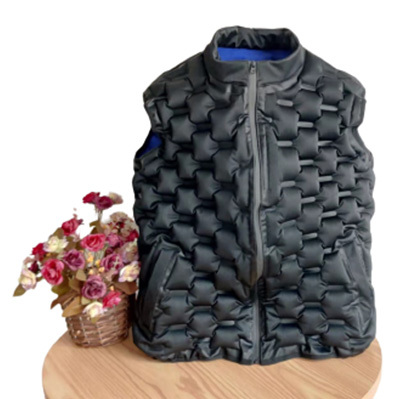
In our own range, this construction appears across a family of colour variants so that teams can match uniforms or use high-visibility shades where needed. You can see a typical example here:
 Black Inflatable Cold Vest FQ-K02Each product is installed on the inside of an inflatable mouth, the use of air nozzle twist open to blow, you can choose the amount of gas injected according to the lo...View Product →
One honest limitation: an inflatable warming vest is not a life jacket. It has no buoyancy certification, and a punctured chamber changes its performance. Keep the two categories separate in your procurement documents, especially when the same crew works near water in winter.
When Air Keeps You Cool Instead
In hot conditions the design goal flips. You are no longer trying to stop heat escaping; you want sweat to evaporate and air to move. An inflatable cooling vest holds a thin layer of air away from the body and, in most designs, combines that gap with mesh panels, moisture-wicking fabric, or channels that let vapour pass through instead of trapping it against the skin.
This is the lightest approach to cooling for people who are already carrying tools, radios, and helmets. Unlike ice-pack or phase-change vests, it does not add weight that has to be replaced every few hours, and it does not create condensation that soaks the shirt underneath. In our experience working with outdoor crews, the inflatable and ventilated styles tend to be the ones people actually keep wearing by the end of a long shift.
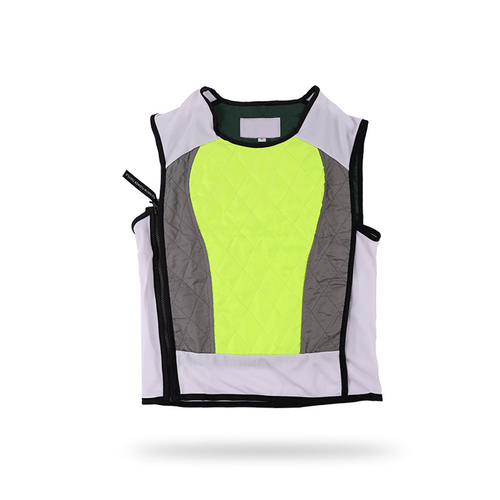
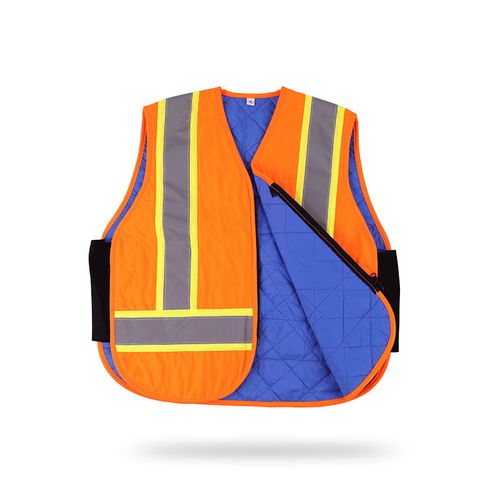
Visibility is often the deciding factor. Vests that sit on the outer layer usually need reflective tape and a bright base colour, and we build these versions for roadside and site work where a supervisor must be seen as well as kept cool.
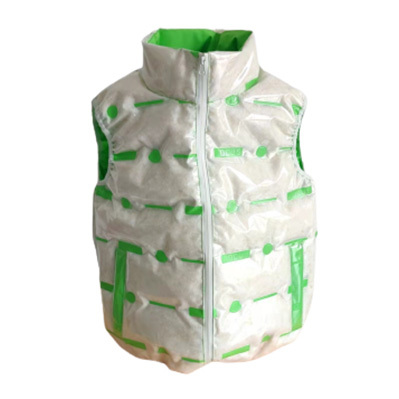
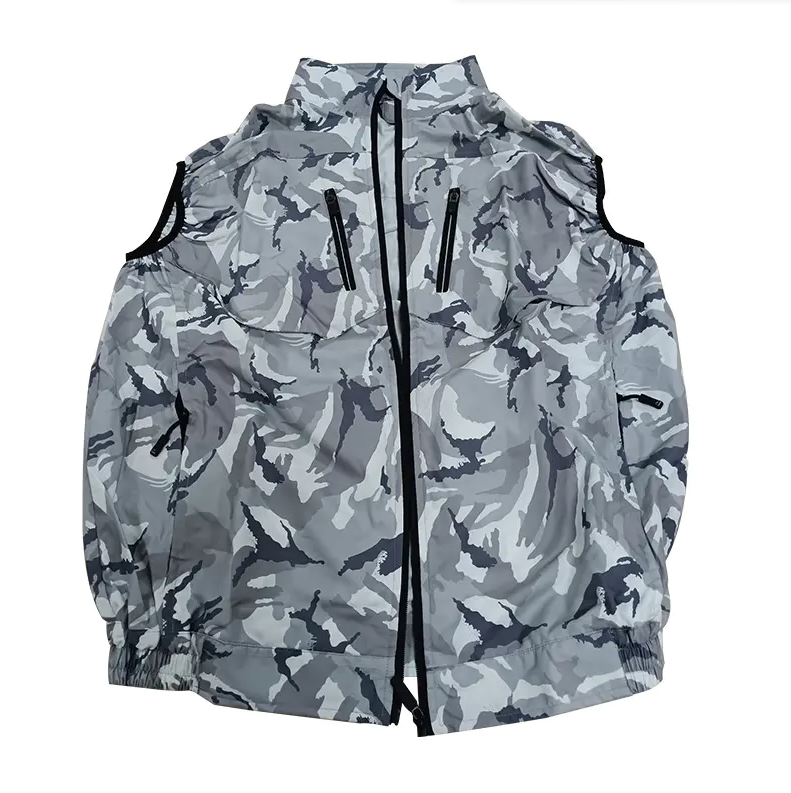
 Outdoor Inflatable vest(FQ-2101)Safety inflatable vest with a double layer of impervious cloth made of the middlehollow vest, the lower right end of the vest is provided with an inflatable mouth, the...View Product →
Inflatable Life Vests: A Different Standard
Because the phrase is so often used for buoyancy products, it is worth being clear about the boundary. A life vest must meet recognised flotation standards, carry a stated buoyancy figure, and in many markets be tested and labelled by an approved body. It is safety equipment first and clothing second, with a completely different set of obligations for the seller.
Thermal garments do not carry those obligations, and they should never be described as if they do. If your project involves crew working over or near water, source certified flotation gear from a specialist supplier and treat any warming or cooling layer as a separate item worn underneath or above it. Being precise about this protects your customers and protects your brand's reputation at the same time.
How to Choose the Right Inflatable Vest
Choosing well comes down to matching the vest to the environment, not to buying the most features. The checklist below covers the points that decide whether a garment is used gladly or left in a locker.
- Purpose first: insulation, heat relief, or flotation, and never a mix of the last with the other two.
- Layering space: measure the chest over the clothing the wearer will realistically have on.
- Valve and chamber design: check how easily it inflates, deflates, and holds pressure over weeks of use.
- Fabric weight and finish: a light ripstop shell for packing, a tougher weave for abrasive site conditions.
- Visibility: bright base colours and reflective tape where traffic or moving machinery is present.
- Maintenance: removable elements, wipe-clean surfaces, and a repair path for punctures.
- Documentation: fibre content, care labels, and any test reports your market requires.
Questions Bulk Buyers Ask First
For wholesale and private-label orders, the conversation usually moves quickly to sample lead time, available colour range, size grading, packaging, and how much of the specification can be adjusted. A well-organised factory will answer these before you commit, and will tell you plainly which requests are simple and which will affect cost. Our own team has written a longer buyer's walkthrough on the site that covers specification traps in more detail: how to choose a safety inflatable vest.
 Safety Inflatable Vest (FQ-2102)Safety inflatable vest with a double layer of impervious cloth made of the middlehollow vest, the lower right end of the vest is provided with an inflatable mouth, the...View Product →
Care, Storage, and a Longer Service Life
Most inflatable garments fail for boring reasons: a sharp edge in a storage crate, a valve left partly open, or a shell packed away damp. A short routine prevents nearly all of it.
- Deflate fully before folding, so the chambers are not creased under pressure for months.
- Air-dry completely, inside and out; trapped moisture is the main cause of odour and fabric damage.
- Store loosely in a dry place away from nails, tools, and direct sun.
- Check valves and seams at the start of each season, and keep a repair patch kit with the garment.
- Clean according to the care label, using mild detergent rather than solvent-based cleaners.
Sourcing Inflatable Vests From a Working Factory
We are Wujiang Fangqi Textile, based in Shengze Town in the Wujiang District of Suzhou, Jiangsu, a textile town with a long manufacturing history and convenient access to the ports of Shanghai and Ningbo. Our factory covers around 4,000 square metres and employs roughly 100 people, and we handle both production and export directly rather than through intermediaries.
Our product development sits around temperature regulation: cold-weather pieces built on inflatable and insulated construction, and cooling pieces built on mesh, evaporative fabric, and ventilated designs, along with headbands, towels, hard-hat pads, and neck protection that support the same goal. Because we produce in-house, we can adjust fabric, sizing, colour, and labelling to suit a range of markets, and our quality team inspects each batch against the agreed specification before packing. If you are exploring a private-label programme, our customization services page explains how that conversation usually begins.
"Inflatable vest" covers more ground than most catalogues admit. Once you separate buoyancy from insulation and from heat relief, the choice becomes straightforward: identify the environment, check the construction details that affect comfort over a full shift, and confirm that your supplier can document what they are shipping.
If you are still weighing options for a winter range, a summer workwear line, or a mixed seasonal order, our team is happy to talk through specifications and send samples so you can compare fabrics and inflation systems in your own hands before deciding.


 3rd Floor, East Gate, No. 2599 Park Road, Sheng Ze Town, Wu Jiang District, Suzhou City, Jiangsu Province
 +86- 0512-63519080
 +86-13584404311
 FQsales1@163.com