
 English
 简体中文

Ask a dozen women what they want from a sports vest and you will hear a dozen different answers, yet most of them circle the same three ideas: it should move with the body instead of against it, it should feel light and dry against the skin, and it should look good enough to wear on the walk home. Those three ideas sound simple. Making them hold true across a full size range is where the real work sits.
We are a textile and garment manufacturer based in Shengze, Suzhou, and our daily work revolves around temperature control clothing — cooling vests for people who work in the heat, insulated layers for people who work in the cold. The same technical thinking runs straight into ladies sports vests, and this article shares what we have learned about getting them right, from the fabric roll to the finished garment on the hanger.
Content
What "Ladies Sports Vests" Actually Covers
The phrase gets used loosely, and that looseness causes problems at the sampling stage. A buyer who pictures a soft yoga tank and a factory that hears "sports vest" and builds a snug compression layer will end up with a prototype nobody is happy with. Before a single fabric is chosen, it helps to settle which of these you are selling.
- Training and lifestyle tanks — relaxed fit, scoop or racer necklines, sold to gym members, walkers and casual activewear shoppers.
- Compression and base layers — close to the body, higher elastane content, worn under a jersey or on their own during high-effort sessions.
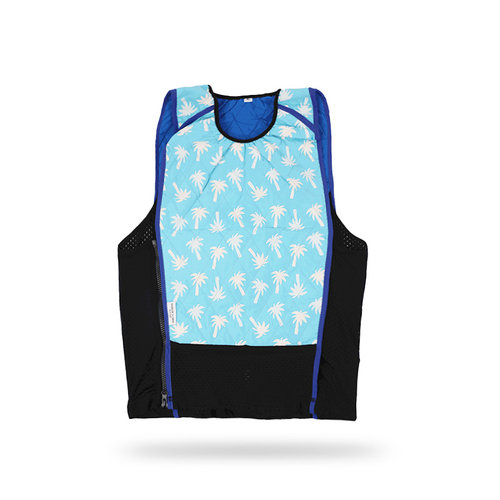
- Cooling sports vests — built with evaporative fabric, phase-change inserts or fans, aimed at runners, hikers, coaches and outdoor workers.
- Reflective sports vests — visibility-first pieces for evening runners and cyclists, often worn as a light outer layer.
Each one carries its own fabric logic, price ceiling and testing requirement. If you are still narrowing down the brief, our complete guide to ladies sports vests walks through the selection criteria in more detail.
Fabric Choice Decides Almost Everything
In our experience, most complaints about a sports vest that "doesn't feel right" trace back to the fabric rather than the pattern. Women notice a lot through the fingertips: whether the surface is smooth or slightly grippy, whether the fabric clings in humidity, whether the hem stays flat after washing. Choosing the knit carefully at the start saves a great deal of correspondence later.
| Fabric | Hand feel | Best suited to | Points to watch |
|---|---|---|---|
| Polyester / elastane jersey | Soft, smooth, quick drying | Training tanks and everyday activewear | Pilling if yarn quality is low |
| Recycled nylon / elastane | Cool, slick, lightly compressive | Compression layers and premium lines | Higher cost, needs careful dyeing |
| Open mesh knit | Airy, textured, fast to dry | Ventilation panels and hot climates | Can snag; check burst strength |
| Cotton-blend jersey | Natural, gentle, familiar | Lifestyle and casual vests | Holds moisture and dries slowly |
| Evaporative cooling fabric | Cool to the touch when damp | Cooling vests for heat and sun | Effect fades without proper care |
Weight matters as much as fibre. A 150 gsm jersey reads as a light summer piece; push it to 220 gsm and the same vest becomes something customers will wear for autumn training. Sampling two or three weights before committing is cheap insurance.
Fit and Pattern: Not Just a Shrunk Men's Vest
We have seen plenty of patterns that were clearly scaled down from a men's block, and they almost always show it. Shoulder slopes are too flat, armholes cut too deep at the back, and the bust area has no room to move. Women tend to notice this immediately, even if they cannot explain why a vest feels awkward.
Three pattern details matter most. First, the armhole shape: a slightly higher and more forward armhole gives coverage without restricting rotation. Second, the strap position: straps that sit closer together are more comfortable on narrower shoulders and reduce the risk of slipping during downward dog or a long run. Third, length: a hem that finishes just below the waistband tends to stay put, while a very long hem can bunch when a wearer bends or cycles.
Grading deserves its own conversation. A common mistake is to grade only in width while leaving length unchanged, which leaves taller customers with a vest that rides up and shorter customers with one that swamps them. We usually grade length in step with the size run, and we always ask for fit approval on a middle size and an end size rather than a single sample.
Cooling Sports Vests for Heat and Hard Effort
Cooling is where our own production history sits, and it changes the design brief considerably. A cooling sports vest is usually worn over a base layer, so the fit needs a little more ease, and the weight of the cooling elements has to be distributed so that it does not pull at the shoulders after twenty minutes. Placement at the upper back and across the chest works well; heavy inserts sitting low on the hem tend to swing and chafe.
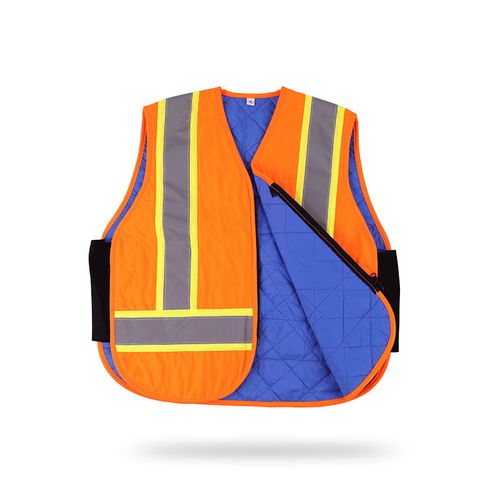
 Orange Reflective Sports Cooling Vest (FQ-2015)A soak-activated cooling vest with reflective strips and 5–10 hours of relief, suited to sports and traffic-safety use.View Product →
There are three routes worth knowing. Evaporative fabrics are the lightest and the most affordable — you wet them, wring them out, and the evaporation does the work. Phase-change packs hold a steady temperature for longer but add grams. Fan-assisted designs move air through the vest and suit very humid conditions where evaporation is slow. None of them is universally better; the right answer depends on where the wearer lives and how long they will be outside.
For sport-specific versions, we build around a few shared features: stretch side panels that keep the vest close without locking the torso, adjustable side straps so one size covers more bodies, and a smooth inner face that will not rub over a thin training top.
 Evaporative Cooling Sport Vest (FQ-2008)A reusable pullover vest with breathable mesh and SAF cooling layer, offering 5–10 hours of relief for running, hiking, and outdoor training.View Product →
Small Details That Get Noticed on the Body
The features that decide whether a vest becomes a favourite are rarely the ones on the spec sheet headline. They are the small things a wearer feels within the first minute.
- Flatlock or bonded seams in places where a bag or strap will press against the body.
- Tagless neck labels or printed care information, because a scratchy label ends repeat purchases quickly.
- Soft-binding armholes that hold their shape after repeated washing.
- Reflective hits on the back or side seams — a low-cost addition that matters for anyone training at dusk.
- Consistent colour matching across sizes, which sounds minor until a retail buyer opens three cartons.
A Practical Sourcing Checklist
When buyers ask us how to compare suppliers for ladies sports vests, we usually suggest putting the questions in writing and asking every candidate the same ones. It makes the answers comparable and saves weeks.
- Can you confirm fabric composition and weight with a test report, not just a description?
- What is the size range, and how is length graded across it?
- Which seams are flatlock, which are overlock, and where does each appear?
- What shrinkage and colourfastness results should we expect after five washes?
- How many sample rounds are included, and what is the lead time for each?
- Can you show a production sample from a previous order in a similar fabric?
- What is the minimum order quantity per colour, and how are size ratios handled?
Working With a Factory on Your Own Design
Most of the buyers we work with are not looking for a catalogue item. They have a sketch, a reference garment or a clear idea of a vest that fits a specific customer, and they need a partner who can move from that idea to a repeatable product. That is the part of the job we enjoy most: sitting with a pattern, adjusting a strap position by a few millimetres, and then watching the fit sample come back right.
Our facility in Shengze runs its own design and production lines, with a quality team checking each batch against the agreed specification before it leaves. If you want to know what is possible on the custom side, the details of our customization service cover the usual options for fabric, colour, sizing, branding and packaging. Orders ship mainly by sea through the nearby ports, with air freight available when a launch date will not wait.
Ladies sports vests look like a simple product from the outside, and that is exactly why the details matter so much. Get the fabric weight, the armhole shape and the seam construction right, and the vest disappears on the body — which is the highest compliment activewear can receive. If you are planning a range and want a manufacturing partner who will talk honestly about what works and what does not, we are always glad to compare notes.

 3rd Floor, East Gate, No. 2599 Park Road, Sheng Ze Town, Wu Jiang District, Suzhou City, Jiangsu Province
 +86- 0512-63519080
 +86-13584404311
 FQsales1@163.com